Showing posts with label Amazon. Show all posts

Sunday, 15 August 2010

Belém of Pará.

If you read the "Lost World" by Arthur Conan Doyle, the expedition party in the Brazilian Amazon to spot the miraculously surviving flying dinosaurs, start from the port of Pará. That was the name of the fortified city at the mouth of the great river, the connection of this most mysterious jungle to the rest of the world. Today this is Belém, in the massive state of Pará. I read this book a few months ago and tried to trace it a bit and I ended up finishing it where I could have started.

Belém is one of most beautiful cities I've seen in a while and this goes a long way. It is simply stunning. Once again I was flabbergasted with the bad reputation it carries. What is wrong with people, don't they have eyes to see and hearts to loose? The architecture is majestic and I don't mean just the center-pieces of its colonial past. Sure, the theater in the main square, the white churches and finely restored mansions, the fort and colourfully tiled fronts neatly stacked behind the docks are excellent. The newly renovated docks too, in a very modern and fashionable take, full of fancy restaurants and boutiques are cool. But in the old city and port, where you have to keep your eyes low for the safety of your steps and your gaze gets overwhelmed by the super-saturated surroundings is where all the secrets lie.

This is where the heart of the city still beats too. The famous marker of Ver-o-Preso has a reputation almost as big as itself. I never managed to get there at its peak (it's 4-5am!) but deliciously lost myself in it nevertheless. The huge tent with the endless stalls cooking on the spot the best food you can ever have and the nearby well stocked native market, the smelly and bustling fishing boats port, the forgotten piles of açai berries on the cobble-stones, the house about life in the Xingu river and the native tribes, people playing checkers with plastic bottle caps and dominoes, siestas in the shadow. Belém is magnificent.

Friday, 13 August 2010

Palms On The Rock.

I've always had a deep fascination with our ancestry and evolution but never came close to any tangible records of it. And when I read that around Monte Alegre there have been discovered caves and artifacts, including wall paintings several thousand years old, I could not resist. The Andes were always thought to be the main hub of prehistoric settlement but apparently during the last few decades signs of human presence have been unearthed in the Amazon basin. And pretty much all of it is right here, a few kilometers away.

The ride to the mountains is dirty and rough but fun. The rocky mounts among deep green, the snaky red soil and the river in the distance are amazing. But the palm prints and obscure red symbols dedicated to sunrise were what put all in context. Don't get me wrong, I love nature and despite never being the first to jump on a chance for a good hike, I'll follow along. But in reality, the presence of marks of human fingers on the earth is the treasure. It's the inescapable link with our past and the rest of the planet. And most of the time it's not as obvious at it sounds .

Thursday, 12 August 2010

Cheerful Mountain.

Word was in Santarém that a nearby town is not to be missed. Not usually visited and with some unique scenery it quickly squeezed in the itinerary. Monte Alegre lies on the north bank of the Amazon, sits atop a hill and furnishes some spectacular views over the river.

The secret lies in the marshland and freshwater lakes at the bottom of the hill. In fact the boat that took me there had to take a sharp turn left a little further down the river to return to the protected little port. This very system of lakes sports the most diverse collection of bird-life in the whole of the Amazon and it's gloriously visible from almost everywhere in the town. The town itself is dominated by the winding uphill roads and ultimately a steep pedestrian pass that leads to a stone ladder just in front of the main square and church.

Of course my favorite points were the port, with the merchandise being in constant move and some weird looking black birds (where they vultures?) roaming the half deserted alleys in the midday heat; and the upper town market with the old ladies gutting fish among smoky taxis, noisy old buses and rainbow coloured fruits. Oh, and hundreds of Moto-Taxis again. The truth is that throughout the town and especially at the above places, my presence was an eye-popping curiosity but I have to admit that most locals did a fairly good job in pretending to be cool about it. They're great people anyway and I can't complain.

Monday, 9 August 2010

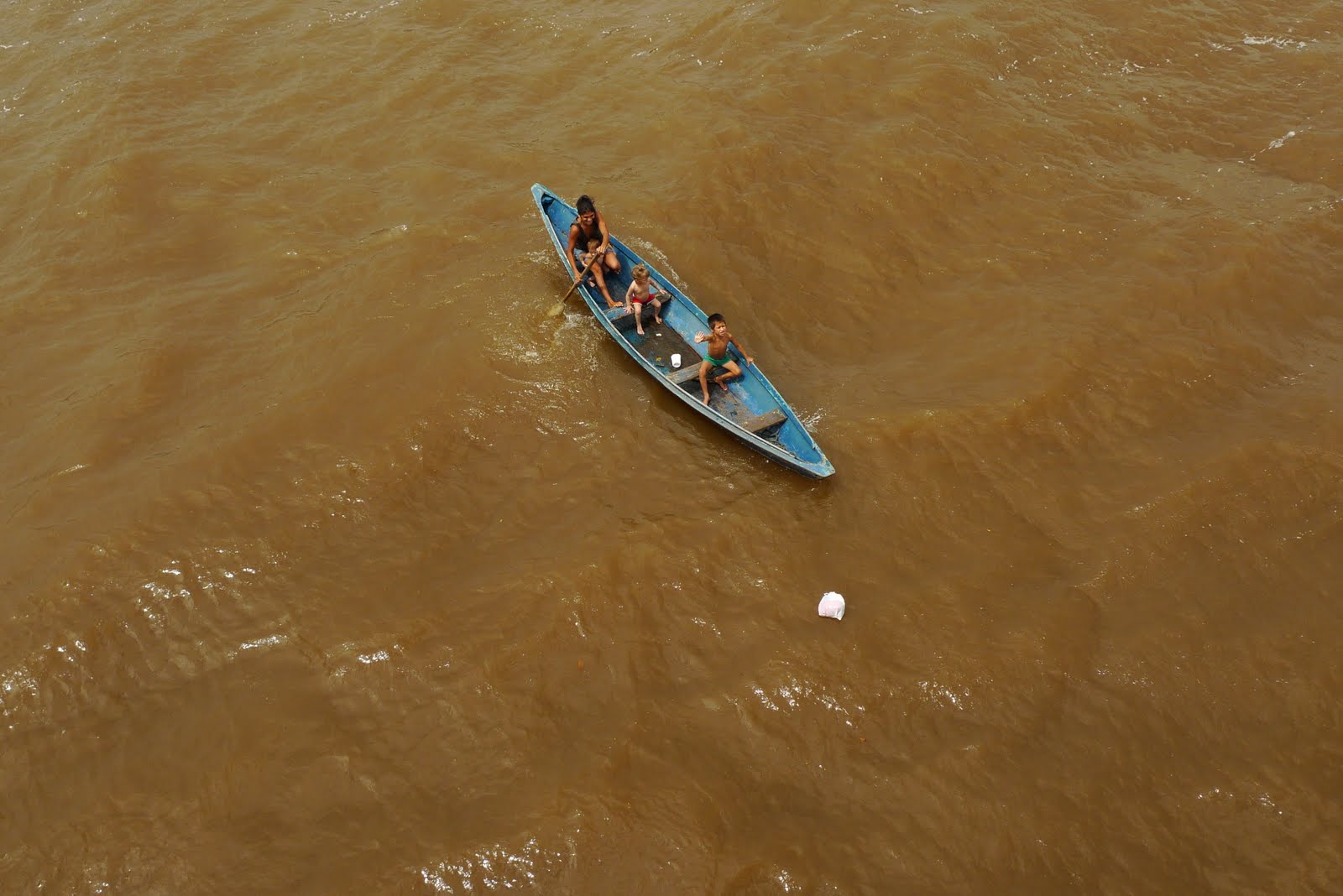
Children With Canoes.

Ok, I admit I was wrong again. When I wrote that small post about Maria Fumaça and elaborated on the singularity of the sentimentality around old steam trains I was wrong. Because I forgot boats and ships. I realized that in a place called the "narrows" as one gets closer to Belém and the ocean. Apparently the accumulation of slit though millions of years has created islands in the river (some bigger than small countries) filling its delta. And accordingly the river narrows down so much that sometimes the banks seem like a stone's throw away.

It was in the narrows then when I first spotted some small dark specs in the water far away, one after the other moving frantically and looking as if they were alive, approaching our ship. Of course they were alive. They were tiny canoes with children and sometimes their mothers on them, paddling towards us and waving, waving all in the same way with their palms facing forwards, moving up and down. Some of them were laughing and some were surprised, with open mouths and still waving.

But the strangest thing for me was that it started raining plastic bags! Dozens of tightly closed plastic bags with food or sweets were thrown from both sides of the ship into the river and the canoes started chasing and fishing them out. It was my turn to have a wide open mouth while waving. Apparently it is customary and the children come out to meet the ships partly expecting their presents.

Lessons of the day: People have the same urge to wave at ships as they do with trains. And the next time I come to Pará I know I'll have to carry some extra gifts.

Sunday, 8 August 2010

Fordlândia.

It was some time ago when I first came across an old and almost forgotten story that fascinated me. I read all I could get, mostly articles. There's not a lot online, bits and pieces here and there, all repeating the same stuff. A recently published book about it I could not get hold of. But then one night at a bus terminal, while killing time by leafing through magazines, I bumped into a recent Brazilian publication with an article titled: "Kill all the Americans; the revolt of the workers in the Amazon against the managers of Fordlândia." That was it, I had to visit this place.

The history of Fordlândia is short but dense and complex. In 1929 Henry Ford bought 15,000 sq.km of jungle on the banks of Rio Tapajós, 100kms south of Santarém, in order to produce cheaply the rubber he needed for his cars. He dreamed, planned and constructed an American Utopia, a complete prefabricated town with water tower, houses with white picket fences, hospital, library, church and of course factories. And with them came industrial production lines, strict working hours and clocks, metal numbered badges, hamburgers, puritanism and prohibition. It even aligned with the time-zone of Detroit. The plantations themselves proved to be a catastrophe mostly because of ignorance and poor planning and it wasn't long till the Brazilian workers revolted against the alien regime and the army had to step in. It was finally 1933 when the town of Fordlândia and its land was abandoned without ever producing a single ton of rubber. It was exchanged for new land downriver and the experiment was attempted once more under the name of Belttera, before having the same fate in 1945. The total cost reached $200 million in modern value. Henry Ford never set foot in Brazil.

The thing that struck me (and tickled my curiosity even further) was the fact that there is almost no reference to Fordlândia's present and very few images of it on the web, nearly all of them old. From what I could tell, it is a ghost town, with rotting old buildings, the jungle reclaiming rusty metal carcasses and the possibility of a few people squatting in the remains. Apparently it is difficult to access and very few outsiders go there.

The truth is a little different. A 12 hour boat trip down Tapajós from Santarém dropped me and half a dozen other people on a little wooden pier, next to an ancient warehouse dressed in broken windows, at 4 in the morning. My fellow passengers and my boat disappeared quickly like ghosts in the dark and all I could see was a brightly lit church atop a hill. With the first light the town took shape. Behind the church massive skeletons of factories and nearby a dominating water tower were instantly recognisable. A few small houses and dirt roads. Far to the north and up another hill there are neat rows of wooden houses with gardens and porches with the promised picket fences by now losing their whiteness. An old petrol station. To the south a long building that turned out to be the old college and the convent.

But Fordlândia is far from deserted. Before sunrise I shared a cigarette with Medreira, he is from Maranhão and has lived here for years. At least a dozen children on their way to school exchanged shy goodmornings with me. Shops opened their doors, motorbikes sped by. At the butcher's I found out there must be at least a few hundred residents, mostly farmers. And a curious 10-year old girl on her way back from the beach wanted to learn where I'm from. She's been here for 5 years maybe and she's bored, "there's not much to do" she says. As for the ruins, her mother told her that some Americans built them long time ago.

Fordlândia today is no ghost town but then again is no Disneyland either. It's isolated but not unreachable, it's surprising and contradictory. It becomes what you want it to be but has its own truth. I found it an organic evolution of an imposed grand scheme, of a capitalist Utopia that reached hubris. It was not what I expected but certainly not less.
Btw, further reading here and this is the book .
And if you are interested, this is a slide-show of the complete story.

On Sandy Beaches with Pink Dolphins.

It was two days in the boat and three or four stop-overs to load and unload hundreds upon hundreds of heavy sacks of nuts and cases of fruits, sweaty travellers with half their livelihoods and liters of tears from their loved ones left behind, until we reached the next large port. Santarém is the smallest of the three trading forts on the Brazilian Amazon and right where Rio Tapajós joins the big muddy snake.

The city somehow manages a delicately low profile, with a colourful and bustling riverfront, beautiful and unassuming wooden houses, endless hammock spreads, car-washers on the spot, moto-taxis, fishing lines and old battered riverboats. And of course the famous pink dolphins with their bumpy noses not far off-shore, fresh water lakes and mysterious farming huts on muddy banks. At the same time it's loud and raunchy after sunset and the heat keeps up in more than one ways.

Tapajós itself is awesome with its turquoise waters and fine sandy beaches, at least during the dry season. And this being the dry season I had a little taste of them. Alter do Chão is the obvious superstar, a sandy stripe of a few meters wide and several more long, like a Lilliputian lost continent in the middle of a bright blue bay. Yet it's full of fun and huts and chairs in the water during the weekends when everybody seems to descend there. On a weekday the spotlights are off and it joins Maracanã and the other jewels in their graceful anonymity.

Friday, 30 July 2010

Amazon.

Rio Negro comes from the dense jungle of the north. It's waters are dark, almost black with the decomposing foliage. Rio Solimões comes from the west, all the way up the Andean tops and carries mud. It's colder, travels faster and its waters are brown. As they meet, a little further downstream from Manaus they travel side by side, without mixing immediately, little swirls doing the introductions like shaking hands, getting to know each other. And after a few kilometers the joined twins are called the Amazon.

Around the meeting of the rivers there's a dense forest of extremely tall trees. They have proper trunks-it's not the jungle and the all fuse at the top to form a green umbrella that follows you around. One of them apparently is the largest tree of the continent. Unfortunately it's name eludes me, it's in one of the indigenous languages. The silence is eerie and the black and blue reflections on the water dreamlike. It's a green, fluid, hallucinating maze.

Victoria Regis is the name of the largest lily of them all. It's only on the Solimões, the Negro's high acidity is prohibiting. The monkeys could be using them as giant pools, springs, hammocks, I don't know what. Their flower is white the first day, pink the second and purple on the third. And then it is no more. Don't go too far searching for another one, it's right there, next to you. And another and another. As far as you can see.

I'm afraid I did not spend that much time in the jungle. And to be honest I do not mind that much. I'm happy I'm here but happier this universe is here. The trip down the river, all the way to the ocean has commenced.

Wednesday, 28 July 2010

Eating Piranhas.

I've wanted to see Manaus ever since I first heard of a city on the banks of the Amazon. Manaus excited me more than the jungle itself. But I had no idea about this place. I'm not sure what exactly I was expecting or even dreaming. It doesn't matter anymore.

Manaus is bigger than I thought, much bigger. And it's not even on the Amazon, it lies on the north bank of Rio Negro, a few kms NW of the meeting of the rivers, where Rio Negro and Rio Solimões join to form the mighty River. It would also be a stretch to call Manaus beautiful or romantic. It certainly has a long and glorious past, especially during the few decades on either side of the beginning of the 20th century, during the rubber boom. Inevitably history took its course and left more than a few scars behind.

But I still fell for it. It's gritty, rough and rusty, with old mansions gutted by an urban jungle, with an amazing amount of street stalls, the heat and humidity of hell and it's grand Opera house smack in the middle. The port is as real as it gets. Fish and grains, hammocks, engines, fruits, umbrellas; all are in a constant move through the eternal sweating of the men. Stalls with fish soup and little corner barbeques, plastic chairs with frozen beer fill in a feverish craze through the ingeniousness of the women.You can find anything you want. I found a salami of tobacco to accompany my hammock on my boat trip.